Pascal's triangle is named after the great French mathematician Blaise Pascal who lived from 1623 - 1662. It is created by a simple game, yet the truths it contains are mysterious, deep, and fun to discover!
To create the triangle start with the number 1 at the top. Each row after is created by adding the values to the left and to the right of each entry in the new row. You can see that generating the second row is trivial - because there is no value to the right or left of the first row, so there is nothing to add and the next row just becomes 1 1. In the third row however there is a left and right value of the middle number - so that row becomes 1 2 1. View the animation below to see how it works:
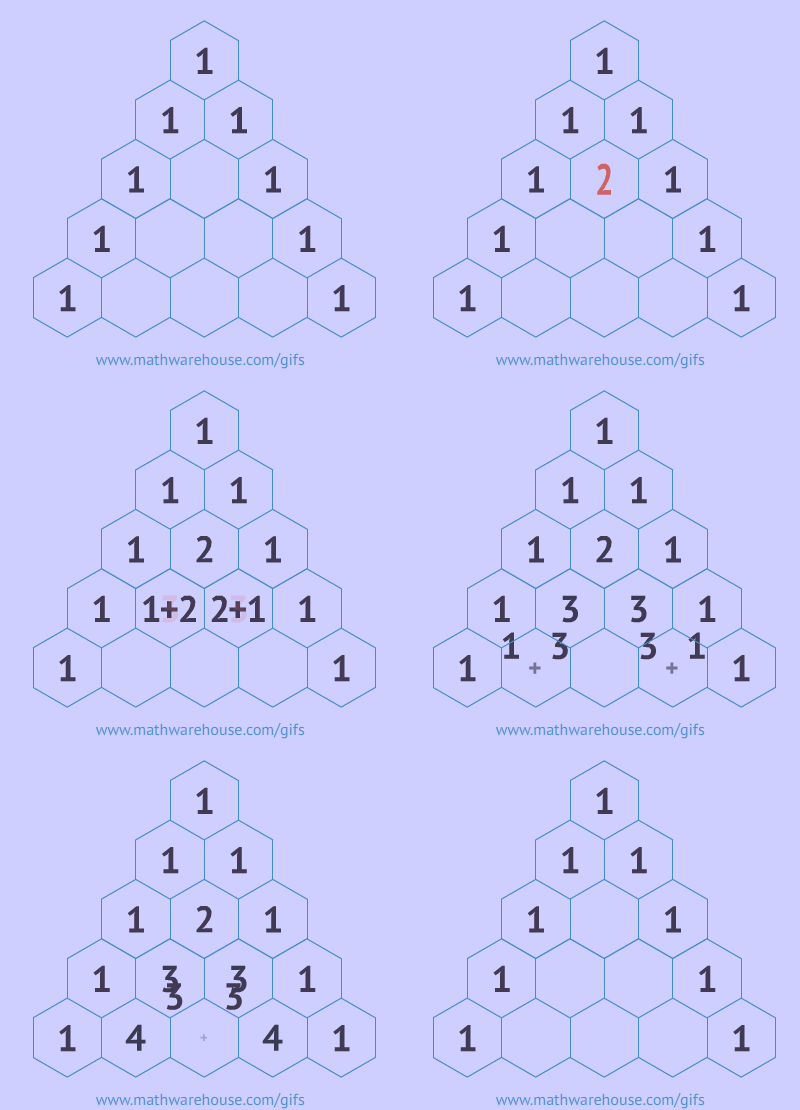
Now give it a try yourself. Create the next three rows using the rule of Pascal. Just click in the empty circles and put in the values you think belong there. If the row(s) is not right you will get a message to try again.
Sigma is just the Greek letter for 'S', and S stands for sum. It is just a shorthand to tell someone how to add up a sequence of numbers. The simple properties of adding numbers is all you need to know to use the properties of sigma summation - but the notation takes a little practice. So as a first example, \(\sum_{n=1}^{12}n=78\) just means add up all the whole numbers from 1 to 12. It is sometimes written like this \(\sum\limits_{n=1}^{12}n=78\).
The bottom expression contains the index variable and the lower bound while the top value is the upper bound. It is always assumed that the index variable increases by 1 to generate the series being summed. The lower bound and upper bound may be numbers or variables. The index is always a variable, and must appear inside the expression being summed.
We are free to change either lower or upper bounds (or both) as long as we keep the same numbers in the sequence to be summed. iFor example if we want to add all the numbers from 1 to 12, we could start with an index value of n = 0, but then we would have to sum the expression n + 1instead of just n, which means that the upper bound would have to be changed to 11. This still specifies that the numbers 1 through 12 are to be summed and would still give us the same answer of 78. The sigma notation would be: \(\sum\limits_{n=0}^{11}(n+1)=78\).
Many sums have a closed form. The classic formula for adding sequential whole numbers was discovered by the great German mathematician Carl F. Gauss (when he was in KINDERGARTEN!). It allows us just to plug in numbers from the bounds with this formula: \(\sum\limits_{n=1}^k=\frac{k(k+1)}{2}~\) which can also be written as \(\sum\limits_{n=1}^k\frac{k}{2}(k+1)\). You will note that in the closed form there is no need to use n, thus making the closed form much easier to compute. For example to add up all the whole numbers from 1 to 100 (as his kindergarten class was asked to do by a teacher that probably just needed a little rest!) we would plug in 100 for k and 101 for k + 1:\(~~\sum\limits_{n=1}^{100}=\frac{100\cdot 101}{2}=5050\).
The story of how he came up with this formula is very interesting as well as instructive: while all the other children were adding up the numbers in order - not on paper but on little chalk boards and furiously scribbling and erasing over and over - Gauss decided to work smart rather than hard. In other words he remembered that it doesn't matter what order we add numbers in (which is called the Commutative Property of Addition), so instead of going "in order" he noticed a pattern - if I add up the corresponding numbers at each end like squeezing an accordion something interesting occurs - a 'magic number' appears. He noticed 1 + 100 gives 101, then 2 + 99 gives 101, and all other number pairs working in from the ends always add to 101. Since he was adding these pairs he realized he could just do one quick multiplication: take how many numbers and divide by 2, giving the number of pairs, and multiply this 'magic number' by the number of pairs. He got the answer in less than a minute! The legend is he presented it to his teacher and the teacher got mad! Remember, the exercise was probably assigned by a tired teacher who wanted a little break from kindergartener chaos for a while, and the 6 year old Gauss spoiled his plan! As amusing as this is it brings in an important point: using the properties of addition such as Commutative and Associative can vastly reduce our work and are an essential tools in Finite Mathematics especially when doing Proof by Induction, which we will study in Section 6 of this chapter.
From observing the 'accordion summation' that Gauss did, we an see that it works no matter what number we start with or end with. So to keep the formula general we can sum consecutive whole numbers between some beginning m and ending k. To do this we consider that summing numbers from a lower bound of m and upper bound of k is the same as summing all the numbers from 1 to k and subtracting the sum of numbers from 1 to one less than m, so that m itself stays in the final sum and does not get subtracted out. If we formulate the problem like this we can then subtract the closed forms of each summation as well. So we then have:
\(\begin{align*}\sum\limits_{n=m}^k n&=\sum\limits_{n=1}^k n~~-~~\sum\limits_{n=1}^{m-1}n\\\\&=\frac{k(k+1)}{2}-\frac{(m-1)(m-1+1)}{2}~~~☛\text{ Substitue closed forms (use }m\text{ - 1 for upper bound of second summation so }m\text{ itself isn't subtracted out)}\\\\&=\frac{k^2+k-m^2+m}{2}~~~☛\text{ Put fraction over common denominator, combine like terms and distribute in the numerator.}\\\\&=\frac{k^2-m^2+k+m}{2}~~~☛\text{ Factor difference of two squares}\\\\&=\frac{(k+m)(k-m)+k+m}{2}~~~☛\text{ Factor by grouping}\\\\&=\boxed{\frac{(k+m)(k-m+1)}{2}}\end{align*} \)
Follow along with the teacher as you go through this lesson. Class notes are provided below to follow along with.
If the notes don't open below you can open them in another browser tab HERE
\(\large{\binom{n}{k}}=\frac{n!}{k!(n-k)!}\)